
The Apple of Gold: The Second Synthesis of the American Ideology

In the American story, liberty and equality have always danced together – two ideals, each shaped by two traditions, each pulling the nation forward in its own distinct way. We have already seen how Americans tempered the exhilarating promise of liberty by rooting it in a deep-seated communal ethic – a uniquely American value of “communitarian individualism.” Rather than letting freedom spiral into selfishness and atomization, liberty in America emerged as something inherently social: individual rights balanced by mutual duties, independence strengthened by bonds of community. Though deeply influenced by Enlightenment thinkers like Locke, it was the Puritan legacy – covenants, neighborhood responsibilities, voluntary associations – that gave liberty its lived form.
Now, we turn to equality, liberty’s equally important yet more elusive twin. At first glance, equality seems straightforward, proclaimed boldly by Jefferson as "self-evident." But despite its central position in America’s founding creed, early Americans rarely used the word explicitly, and its practical meaning remained vague and contested. It was, in fact, not at all self-evident to the early Americans what "equality" truly entailed. Whereas liberty rapidly became a core part of the American political vernacular, equality's meaning was less fully formed, more contested, and arguably secondary during America’s earliest decades.
The roles of Puritanism and the Enlightenment effectively reversed when it came to equality. Liberty, restrained and refined by Puritan ideals, emerged balanced and intelligible. Equality, by contrast, fractured. Enlightenment thought emphasized juridical equality – equal rights before the law, self-ownership, impartial statutes, the clearing away of artificial privileges. Puritan thought offered covenantal mutualism – a communal equality rooted in the imago Dei, stressing obligation, charity, and shared accountability.
Neither idiom was sufficient on its own. Juridical equality, thin and abstract, could guard autonomy but lacked a compelling moral call. Covenantal equality, rich and demanding, could inspire communal care but easily turned paternal, cloaking power in the garb of benevolence. Together they produced not a synthesis but a muddle. The republic became a “house divided” not only geographically between slave and free states, but philosophically between rival definitions of equality – an incoherence that left the nation vulnerable, its soaring promise twisted into defenses of slavery and exclusion.
And yet, even in contradiction, Americans never abandoned the one revolutionary truth that set them apart from Europe: no man bore in his blood a birthright to rule another. The rejection of caste was the most radical idea of the founding – and, arguably, of modernity itself. Whatever else equality meant, it began with this negation: that birth would never dictate civic standing.
Rejection of Ascriptive Class: The Cornerstone of American Equality
The United States was born out of a negation. What it cast aside was not merely a king or a ministry, but an entire ascriptive ontology – the ancient belief that some are born to rule and others to obey, that lineage, not liberty, fixes a man’s station.
In the Old World, hierarchy was not simply political but metaphysical. Nobility and peasantry, master and serf, were treated as natural categories of existence. To be born was to inherit an immovable place in society, with the “accident of birth” consecrated by centuries of custom and sanctified by law.
In America, this ontology did not collapse overnight, but it eroded quickly in a setting poorly suited to sustain it. The first generations of settlers came disproportionately from what Europe scarcely recognized as a class at all – the middling ranks of artisans, yeoman farmers, and gentry-citizens. Unlike Spain’s empire in the South, where noble families transplanted their estates, or Britain’s aristocratic ventures in the Caribbean, most North American colonists arrived without pedigrees to defend. Where aristocratic pretension did surface – among southern planters or the great estates of New York – it was met with suspicion, often mocked as alien to American life. Revolutionary zeal transformed this ridicule into principle: titles of nobility were proscribed, hereditary orders derided, and the very notion of blood conferring superiority dismissed as absurd. What collapsed was not just a set of customs but the plausibility of hierarchy itself, a demolition Gordon Wood calls the Revolution’s most radical legacy. Equality, in its earliest American sense, meant above all the negation of inherited rank.
What made this rupture distinctive was how swiftly it hardened into cultural reflex. Canada retained a Loyalist elite; Australia a penal hierarchy; Latin America sprawling haciendas under creole nobility. In the United States, by contrast, aristocratic ambition invited ridicule rather than deference. To call a man “lord” or to ape the manners of the English gentry was to invite mockery, not respect. Satirists from Benjamin Franklin to Mercy Otis Warren lampooned pretensions of rank, while legislatures codified the ban by outlawing hereditary privilege. This irreverence mattered. It turned a structural absence – the lack of entrenched nobility – into a civic creed. Equality was not merely declared; it was enacted daily in the deliberate derision of birthright rule.
If America’s Revolution seemed modest at first glance – “a revolution of shopkeepers,” as its detractors sneered – it proved in retrospect the deeper rupture. The French, only a few years later, thundered their magnificent slogans of liberté, égalité, fraternité, yet could never shake two millennia of feudal inheritance. They beheaded kings and proclaimed universal brotherhood, but aristocracy returned in altered forms: empire succeeded republic, hierarchy endured. America’s little rebellion, cautious in politics and modest in demands, quietly demolished hereditary station. The revolution of farmers, printers, and merchants cut deeper into human history than the revolution of Parisian mobs.
The symbolic choices revealed the depth of the rupture. George Washington, who could have crowned himself king, consented instead to be addressed simply as “Mr. President.” The framers, many aristocrats in taste if not in title, wrote an explicit ban on nobility into the Constitution. In town halls and jury boxes, blacksmiths and farmers rose to speak as if they bore the same authority as lawyers and magistrates. Everyday gestures – forms of address, rights to assemble, the expectation that one might rise – were turned against the presumption of inherited rank.
Yet the revolution was incomplete. Slavery mocked the claim that no man was born subordinate. Women and Indigenous peoples remained outside the circle of equality. But even in contradiction, the old ontology had been shattered. Once nobility was abolished, once ascription was refused, the solvent of equality began its work – seeping into every debate, every crisis, every demand that America live up to its creed.
Modern critics, however, argue that America’s ideology is not defined by the absence of ascriptive class but by its persistence – that caste and exclusion remain the nation’s defining truth. Rogers Smith, for instance, interprets American history through its failures of equality, emphasizing that the republic never fulfilled Jefferson’s promise. If Smith is right, then our history should read as the steady entrenchment of caste, each generation refining new forms of hierarchy.
But that is not our story. Ours is the opposite: every movement of reform, every advance in dignity, has appealed not to some alien gospel but to the founding creed itself. The Declaration’s words were not ornamental; they were the engine of progress. Abolitionists, suffragists, civil rights leaders – each invoked the nation’s rejection of ascriptive class not to create a new principle but to demand a truer application of the one already proclaimed.
This is why the rejection of ascriptive class must be counted as America’s most radical inheritance. It created the empty space where new meanings of equality could take root. It gave abolitionists their grammar, women’s rights advocates their claim, and Lincoln his “apple of gold.” However marred in practice, the foundation endured: no soul enters the world stamped with the right to rule or the duty to submit. In that absence lay the seed of all that would follow.
The Puritan Roots of Moral Equality: Imago Dei & Covenantal Mutualism
At the heart of early American moral imagination lay a powerful theological truth: every human being bears the imago Dei, the image of God. For the Puritans this was not an abstraction; it was a profound claim of ontological equality. The point was not that all men were equally well-born or virtuous, but that all souls equally reflected the divine nature. Humanity’s dignity was not earned or inherited – it was bestowed at origin, a reflection of God’s breath in creation. This principle was foundational: it preceded rights, law, and even society itself. All people, by birth, shared the same sacred worth.
But this equality was never simply individual, it was profoundly communal. The Puritan political order rested on covenantal mutualism, the belief that individuals enter into ethical bonds of obligation with one another, grounded in a sacred contract with God. In Puritan colonies, all relationships – between pastor and people, magistrates and townsfolk, neighbors in settlement – were defined in covenantal terms. They were bound not by arbitrary force but by mutual responsibility, lived discipline, and shared accountability. John Winthrop’s Model of Christian Charity captured this spirit, urging settlers to “bear one another’s burdens” and to knit themselves “more nearly together in the bonds of brotherly affection.”
The Puritan ideal did not elevate the independent individual or treat autonomy as supreme. Instead, it taught: you are equally divine in worth, and therefore equally obligated to your neighbor. To be made in God’s image was to be called into a community of equals – each with duties, each with mutual obligations, each anchored in divine accountability. Modern interpreters of imago Dei echo this point: if God loves us equally, then we are bound to imagine and build a community that makes it easier to love one another.
This Puritan moral architecture created a difficult but vital tension. It affirmed individual dignity not as atomized selfhood but as a gift entrusted to community. It recognized that love of neighbor depends on seeing the image of God in another – and that this vision becomes real only when people bind themselves together in responsibility. Covenantal mutualism was not an abstract nicety but a social ethic that demanded both equality of status and equality of care.
Yet this tradition never stood alone. It could be distorted, as slaveholders did, into paternalistic justification: if equality means each person requires moral guidance, then “benevolent guardianship” of the enslaved could be framed as virtuous. Likewise, the covenantal ethic could be used to curtail autonomy and impose hierarchy in the name of social harmony. Left by itself, imago Dei and covenantal mutualism could illuminate moral equality – or corrupt it.
That is why moral equality in America did not emerge organically. Its Puritan roots gave it depth and sanctuary, but only when joined with Enlightenment self-ownership could equality be shielded from paternalism and grounded in freedom.
The Enlightenment Roots of Equality: Self-Ownership & Juridical Rights
If the Puritans rooted equality in the imago Dei and bound it within covenants of mutual responsibility, the Enlightenment offered a different idiom altogether. For Locke and his heirs, equality meant that no man is born the natural ruler of another. Nature confers no titles, and bloodline bestows no privilege. Political order rests not on inherited hierarchy but on the equal ownership each person has of himself.
This was the foundation of what may be called juridical equality: the insistence that all stand equal before the law, each possessing the same claim to life, liberty, and property. It was a thinner equality than the Puritan’s covenantal moralism, but it was also sharper, more disruptive of Europe’s ascriptive orders. Jefferson’s words in the Declaration – “all men are created equal” – were drawn directly from this idiom. They declared that government must rest on consent because no man has a rightful claim to govern another without it. From this premise flowed rights of conscience, speech, property, and the rule of impartial law.
The Enlightenment’s equality was individualistic rather than communal, protective rather than paternal. Its purpose was to clear away artificial barriers – the privileges of aristocracy, the monopolies of guilds, the inherited prerogatives of church and crown – so that individuals could pursue their lives without interference. Where the Puritan covenant demanded obligation, the Enlightenment contract demanded neutrality. To be equal was to be uncoerced, shielded from domination by the impartiality of law.
But this vision had limits. Precisely because it was abstract, it could be narrowed in application. Many of the founders could affirm equality in principle while denying it in practice to women, Indigenous people, or enslaved Africans – because juridical equality applied only to those recognized as rights-bearing citizens. And because it leaned so heavily on property as the cornerstone of liberty, Enlightenment equality could even be twisted into its opposite: the supposed “right” to own slaves, defended as an extension of property rights.
Still, the Enlightenment legacy was indispensable. Without it, equality would have remained a moral sentiment without legal teeth. With it, Americans could claim that rights were universal, self-evident, and inherent to personhood. The juridical strand gave equality its sharpest legal edge, even as the Puritan strand gave it its richest moral depth. The tragedy of the early republic is that these idioms remained divided – each partial, each vulnerable to distortion – until Lincoln’s synthesis united them in a single claim: that dignity (imago Dei) and autonomy (self-ownership) are one and the same.
Liberty Before Equality
From the Revolution through the early Republic, liberty was the lodestar of American political thought. Colonists understood themselves first as freeborn Englishmen unjustly deprived of their rights by Parliament. Equality was not absent, but in practice it functioned more as a leveling among citizens of the polity than as a universal declaration about all persons.
Philosophically, the founding generation leaned heavily on Locke’s framework: liberty as man’s natural condition, secured by consent, with property as its chief expression. Jefferson, Madison, and others described liberty as the essence of self-rule. The Declaration placed equality first in grammar (“all men are created equal”), but in political usage liberty became the operative term. State constitutions echoed this priority, enshrining the language of liberty and rights far more frequently than that of equality.
This preference shaped abolitionist rhetoric as well. Both Puritan and Enlightenment notions of equality were present at the founding, but anti-slavery activism in the decades before the Civil War drew primarily on the language of liberty. Early opponents of slavery focused less on declaring racial equality than on condemning the theft of freedom itself. Many white Americans, even those opposed to slavery, hesitated to claim Black people as their equals in every respect. What they could affirm was that slavery cruelly denied the basic liberty and natural rights to which all humans were entitled.
Abolitionist tracts therefore spoke the idiom of freedom, rights, and Christian duty more often than that of equality. In 1843, Henry Highland Garnet – a formerly enslaved Presbyterian minister – urged the enslaved to resist their oppressors, declaring: “In every man’s mind the good seeds of liberty are planted… he who brings his fellow down so low as to make him contented with slavery, commits the highest crime against God and man.” Garnet grounded his plea in both divine and natural law, presenting liberty as the universal impulse implanted in the human soul. Likewise, David Walker denounced white Christian slaveholders for their hypocrisy, insisting that unless America relented, enslaved people would claim their God-given liberty by force. “Treat us like men,” he warned, “and we will all live in peace and happiness together.”
In sum, antebellum anti-slavery discourse consistently defaulted to liberty. Equality appeared as a premise – acknowledged in Jefferson’s words or implicit in Christian brotherhood – but rarely as the explicit centerpiece. It would take Lincoln to elevate equality itself into the nation’s central war aim.
The Middle Period: Equality in Contradiction
The imbalance between liberty and equality, so evident in the early Republic, became the central problem of the decades between 1815 and 1860. Liberty remained the watchword of political life, while equality – proclaimed but undefined – was pulled in rival directions. Sectional conflict and chattel slavery forced Americans to grapple with equality more directly. What had been implicit could no longer remain in the background.
America had rejected aristocracy: no titles, no hereditary orders, no entrenched nobility. Yet in its place, other ascriptions took root. Race hardened into caste, and geography itself became a marker of identity. The nation possessed equality of rank but not equality of standing. What emerged was not synthesis but fracture: competing vocabularies of equality, each partial, none reconciled, all vulnerable to distortion.
The Puritan language of communal obligation, once a source of solidarity, could be perverted into paternalism. Slaveholders argued that enslaved people required guidance, recasting domination as benevolent stewardship. At the same time, the Enlightenment language of rights, so powerful in theory, was narrowed into defenses of property – twisted to claim that slavery was protected as an owner’s right. Each strand of equality, taken alone, became a tool of oppression rather than liberation.
Jacksonian democracy compounded the fracture. Andrew Jackson presented himself as the tribune of “the people,” pledging to resist “aristocratic combinations.” Yet his “people” were only white men. Suffrage expanded, deference collapsed, but equality was defined ever more narrowly – secured for some by excluding others. Indian removal and the entrenchment of slavery became the hidden costs of white equality. Populism, then as now, combined radical leveling within with exclusion without.
Other voices made the betrayal explicit. John C. Calhoun, in his Disquisition on Government, dismissed Jefferson’s maxim as “the most dangerous of all political errors” – a “self-evident lie.” Society, he argued, required “the necessary existence of classes,” with liberty defined not universally but as “the liberty of the superior to command, and of the inferior to obey.” In 1837, he declared slavery “instead of an evil, a positive good.” Equality was not vague or partial here – it was flatly denied.
Stephen Douglas reduced equality to procedure. “I do not regard the Negro as my equal,” he told one debate audience in 1858, “and positively deny that he is my brother or any kin to me whatever.” In his system, equality meant nothing more than the right of each territorial majority to vote slavery up or down. Jefferson’s self-evident truth was hollowed out, reduced to a matter of counting noses. Lincoln was right to accuse Douglas of turning the Declaration into “a mere nothing – a rhetorical flourish.”
Meanwhile, President James Buchanan deferred responsibility to the courts. After Dred Scott (1857), he insisted the issue of slavery was “settled… with the voice of the Constitution itself.” That “voice” was Chief Justice Taney’s infamous declaration that Black Americans “had no rights which the white man was bound to respect.”
Thus in the Middle Period, equality was distorted and betrayed. Jackson provincialized it, Calhoun denied it, Douglas proceduralized it, Buchanan outsourced it. What had begun as America’s most radical inheritance – the rejection of ascriptive class – was dismembered in practice. The nation, unmoored from balance, slid toward sectional fracture and ultimately war.
The warning for us is stark. A republic that cannot reconcile liberty and equality drifts into crisis. In the Middle Period, equality fractured into incompatible idioms – communal duty turned paternal, rights language reduced to property, democracy devolved into ochlocracy. The United States had abolished aristocracy but failed to define equality. The result was polarization, sectional sorting, and civil war.
If today we again find ourselves polarized, geographically sorted, riven by grievance, and watching communitarian individualism collapse while new movements reject our liberal inheritance, then perhaps we have drifted back into something like that age. And just as then, only a renewed synthesis can save us.
Lincoln’s Synthesis Painted in The Apple of Gold
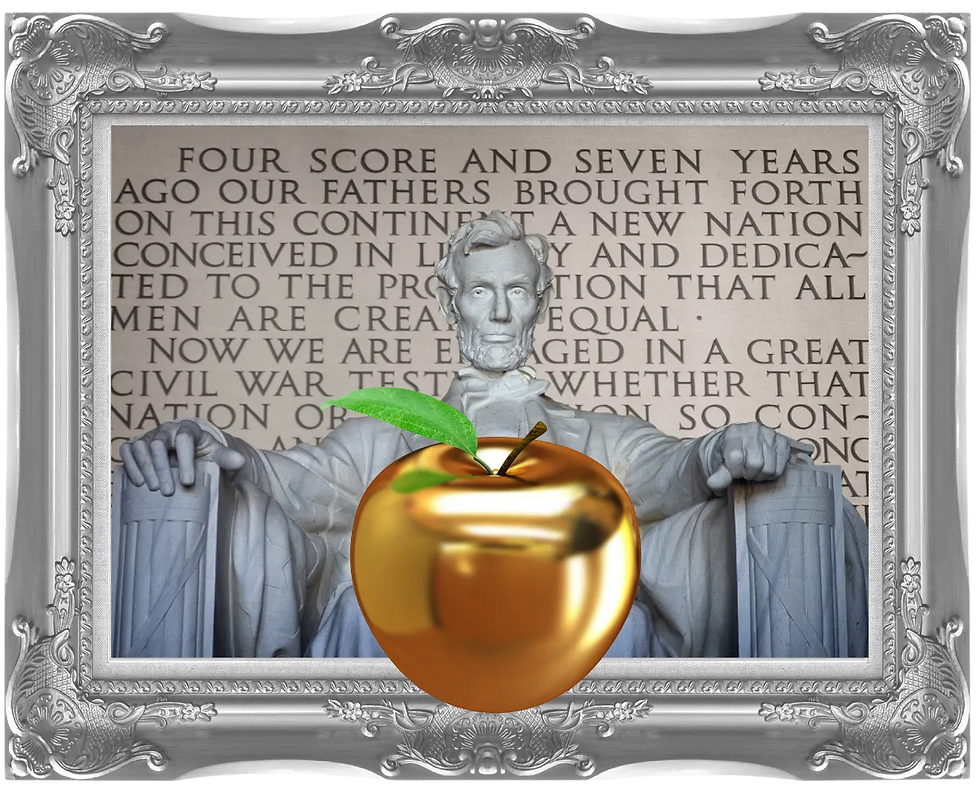
In 1861, at the height of sectional crisis, Abraham Lincoln drafted a short fragment – never delivered, likely intended for a speech – that posterity titled the “Apple of Gold.” In a few spare paragraphs, he gave his clearest account of the relationship between the Declaration of Independence and the Constitution, and in doing so, articulated the synthesis that rescued both the American Ideology and the Union: the primacy of moral equality as the nation’s core idea.
Lincoln began with a metaphor from Proverbs 25:11: “A word fitly spoken is like apples of gold in pictures of silver.” He applied it to America’s founding documents. The Declaration of Independence, with its affirmation that “all men are created equal,” was the apple of gold – luminous, precious, the core truth. The Constitution was the frame of silver – valuable in its own right, but designed to protect and display the fruit. The frame existed to preserve the principle, not to obscure or contradict it.
This was a direct repudiation of pro-slavery constitutionalism. Southern theorists like Calhoun had turned the Constitution into a shield for hierarchy, insisting it enshrined slavery as permanent. Lincoln reversed the logic: the Constitution had authority only because it safeguarded the Declaration’s promise. Equality was the nation’s organizing principle; union and governance were the means.
Here Lincoln completed what fifty years of drift had obscured. He joined the Puritan conviction that every soul bears the image of God with the Enlightenment insistence that each person owns himself. Dignity and autonomy – sacred worth and self-possession – were not rival idioms but two halves of a single truth. Equality was not sameness of station but equality of moral status: the universal negation of domination, the refusal to let birth, color, or condition dictate civic standing.
Lincoln’s antagonists saw the danger. Douglas accused him of trying to “Africanize” the republic by insisting that Black Americans shared in the Declaration’s equality. Calhoun’s disciples sneered that Jefferson’s maxim was “a self-evident lie.” The Democratic press mocked him as a naïve “Black Republican” lost in abstractions. But Lincoln understood what they refused to see: if the apple of gold were abandoned, the republic itself would rot from within.
From his Peoria speech in 1854 to his Second Inaugural, Lincoln returned to the same fusion. “Nothing stamped with the Divine image was sent into the world to be trodden on,” he declared – grounding equality in imago Dei. “In giving freedom to the slave, we assure freedom to the free,” he told Congress in 1862 – binding liberty to equality so that each became the guardian of the other. Emancipation and the Thirteenth, Fourteenth, and Fifteenth Amendments were not merely policy adjustments. They were the first full enactment of an American creed that joined communal obligation with individual autonomy, and placed moral equality and liberty together as the Republic’s highest ends.
Lincoln’s achievement was not to replace liberty with equality, but to show that equality was just as much the end of the American experiment as liberty itself. Before Lincoln, equality had been treated largely as an instrument: it guaranteed freedom by denying inherited rank, but freedom remained the goal. Lincoln reversed that imbalance. He declared that liberty matters because it secures equal worth, and equality matters because it dignifies liberty. Each became both means and end. Together they formed the apple of gold – the enduring purpose of the American republic.
The Delayed Synthesis
From the first New England towns to the western frontier, Americans confronted a daily problem: how could fiercely self-reliant settlers govern themselves without tearing their communities apart? Town meetings, militias, church covenants, barn raisings, and emerging markets all demanded cooperation even as they honored personal initiative. Because the clash between autonomy and obligation was experienced face-to-face – who cleared the road, who paid the schoolmaster, who fined the drunkard – colonists improvised a workable ethic almost instinctively: do your own thing, but show up for your neighbors. Out of those routines grew the cultural habit Tocqueville later called “self-interest rightly understood,” the seed of communitarian individualism.
Balancing liberty required no group to surrender entrenched privileges; it only asked individuals to temper self-help with mutual aid. Equality, by contrast, was more destabilizing. It challenged an economic order in which millions of enslaved people were legal property. Even amidst comparatively equal conditions, society still rested on racial, gender, and class hierarchies. A synthesis that threatened so much capital, labor, and status could never arise “organically.”
Puritan covenantal duty and frontier individualism could be framed as complementary: freedom flourishes when undergirded by moral responsibility. But when it came to equality, the idioms diverged. Covenantal mutualism stressed paternal obligation; Enlightenment self-ownership stressed strict non-interference. Until someone articulated how dignity and autonomy reinforced one another, the two vocabularies blurred more than they clarified.
Thus communitarian individualism emerged early because ordinary life demanded it, interests did not fear it, and institutions could absorb it. Equality remained deferred, postponed so long as human bondage endured. Any robust claim that all men are created equal threatened to ignite sectional crisis. Politicians therefore spoke far more readily of “freedom” than of “equality.” Only the Civil War – when the price of contradiction became existential – forced the nation to complete the second synthesis and accept equality as liberty’s co-equal end.
In the crucible of war, Lincoln forged that synthesis. By joining the Puritan claim that every soul bears God’s image with the Enlightenment claim that each person owns himself, he reconciled moral dignity with individual autonomy. His insight was that liberty and equality were not rivals but partners – each both means and end, each safeguarding and ennobling the other. Equality was no longer a vague aspiration or mere condition of liberty. It became, alongside liberty, the telos of the American creed.
Living up to that creed has never been easy. The Civil War did not bequeath equality upon the nation once and for all; it revealed that liberty and equality exact a cost that must be paid in every generation. A republic founded on a creed must remain ever vigilant to survive. The proud history of America can be told in part through the victories of that vigilance – women’s suffrage, civil rights, marriage equality – each a fresh enactment of the original synthesis.
And yet, here we glimpse another paradox of the American creed. The instinct born of our commitment to equality has often found its noblest expression in the struggles of those excluded from it – enslaved Africans, women, immigrants, religious minorities, the poor. These movements were not departures from the American tradition but its most authentic fulfillment. They drew from the well dug at the Revolution: the rejection of ascriptive class, the refusal to let birth dictate civic standing.
In time, however, some of these movements have drifted into something else. By defining persons chiefly through categories of identity, they risk obscuring the individual – the bearer of liberty, conscience, and responsibility. Equality fights, by their nature, appeal to solidarity and collective grievance. At their best, they enlarge the circle of belonging; at their worst, they threaten to re-inscribe persons into new ascriptive categories, trading one form of caste for another.
What begins in the spirit of Lincoln – appealing to equality as the universal premise of dignity – risks ending in the spirit of Calhoun, reducing civic status once again to inherited categories. Tocqueville foresaw this danger when he warned that the democratic passion for equality, unmoored from liberty, could devour conscience and the sanctity of the individual.
The American genius has always been to correct course: to remind itself that equality is not sameness but equal dignity, the moral worth of each person; and that liberty is not license but the condition for that dignity to flourish. Without equality, liberty degenerates into privilege. Without liberty, equality hardens into conformity. The American Ideology is not a static creed but a balancing act. Its vitality lies in the tension, not in the triumph of one value over the other.


Bài viết rõ ràng, dễ hình dung quá, cảm ơn bạn đã chia sẻ. Mình dạo này cũng hay đọc về nghe nhạc số và DAC để xem người ta mô tả trải nghiệm và cách set up. Mình không đi sâu từng mẫu, chỉ muốn tổng hợp thông tin cho dễ theo dõi nên làm một trang riêng. Ai quan tâm thì ghé xem thử https://www.scener.com/@soicauxsmbpro